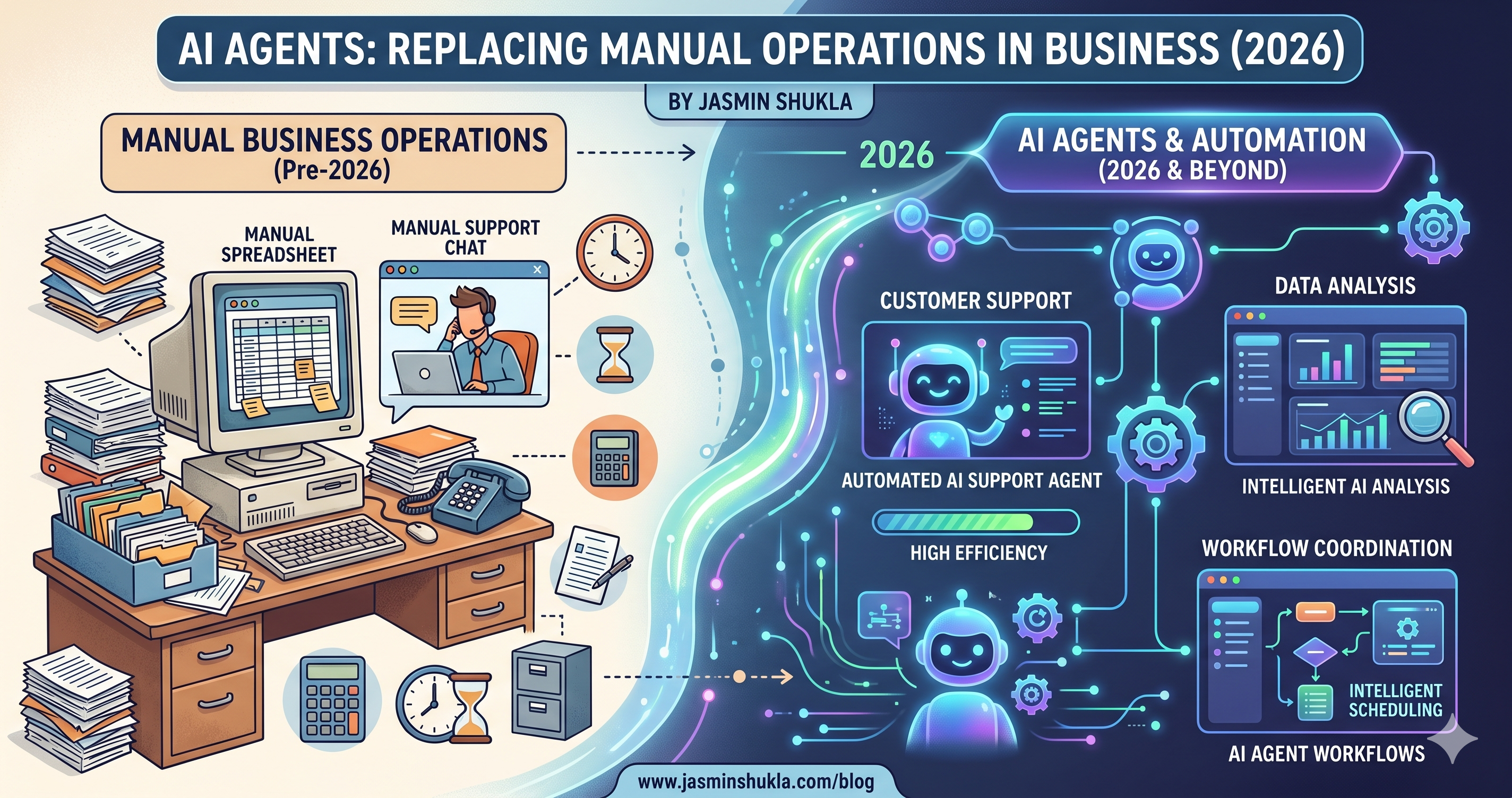
How AI Agents Are Replacing Manual Business Operations in 2026
Introduction
The way businesses operate is undergoing a fundamental transformation. For decades, organizations relied heavily on human-driven processes to manage customer support, sales operations, data entry, finance, recruitment, and countless administrative tasks. While these processes helped companies grow, they often came with limitations such as higher operational costs, slower execution, and increased risk of human error.
In 2026, a new generation of intelligent systems known as AI Agents is changing the game.
Unlike traditional automation software that follows rigid rules, AI Agents can understand objectives, analyze information, make decisions, interact with multiple systems, and complete workflows with minimal human involvement. They are becoming digital teammates that help businesses operate faster, smarter, and more efficiently.
As AI adoption accelerates across industries, organizations that embrace AI Automation and Business Process Automation are gaining significant competitive advantages. The conversation has shifted from whether businesses should adopt AI Agents to how quickly they can implement them effectively.
In this guide, we'll explore how AI Agents are replacing manual business operations, where they're delivering the most value, the benefits they offer, potential challenges, and practical steps businesses can take to begin their AI transformation journey.
What Are AI Agents?
An AI Agent is an intelligent software system capable of autonomously performing tasks by understanding goals, processing information, making contextual decisions, and executing actions.
Traditional automation tools operate based on predefined rules. For example, if a customer submits a form, the system may trigger an email response. AI Agents go much further.
They can:
- ▸Understand natural language requests
- ▸Analyze structured and unstructured data
- ▸Learn from interactions and feedback
- ▸Connect with multiple business applications
- ▸Execute multi-step workflows
- ▸Adapt to changing conditions
- ▸Provide recommendations and insights
Think of an AI Agent as a highly efficient digital employee that can work 24/7 across multiple business systems without requiring constant supervision.
Traditional Automation vs AI Agents
| Feature | Traditional Automation | AI Agents |
|---|---|---|
| Rule-Based | Yes | Partial |
| Learns from Data | No | Yes |
| Decision Making | Limited | Advanced |
| Natural Language Understanding | No | Yes |
| Multi-System Workflows | Basic | Advanced |
| Adaptability | Low | High |
| Context Awareness | Minimal | Strong |
The shift from simple automation to intelligent AI Agents represents one of the biggest changes in business technology since the rise of cloud computing.
Why AI Agents Are Becoming Essential in 2026
Several market forces are accelerating AI Agent adoption.
1. Rising Operational Costs
Businesses continue to face increasing expenses related to hiring, onboarding, training, infrastructure, and operational management.
AI Agents help organizations reduce costs by automating repetitive and time-consuming activities that previously required dedicated personnel.
2. Growing Customer Expectations
Modern customers expect:
- ▸Instant responses
- ▸Faster service delivery
- ▸Personalized experiences
- ▸24/7 availability
AI-powered systems enable businesses to meet these expectations without dramatically increasing staffing costs.
3. Talent Shortages
Many industries struggle to hire qualified professionals for repetitive operational roles.
AI Agents help fill operational gaps while allowing existing employees to focus on strategic and creative responsibilities.
4. Advancements in AI Technology
Recent improvements in:
- ▸Large Language Models (LLMs)
- ▸Agentic AI Systems
- ▸Workflow Orchestration Platforms
- ▸Vector Databases
- ▸Retrieval-Augmented Generation (RAG)
have made AI Agents significantly more reliable, capable, and business-ready than previous generations of automation tools.
Business Operations Being Replaced by AI Agents
Customer Support Automation
Customer service departments are among the biggest beneficiaries of AI-powered automation.
AI Agents can:
- ▸Answer customer questions instantly
- ▸Resolve common support requests
- ▸Track orders and shipments
- ▸Process refund requests
- ▸Handle ticket classification
- ▸Escalate complex issues to human representatives
Example Workflow
- ▸Customer submits a support request.
- ▸AI Agent analyzes the issue.
- ▸Retrieves relevant information.
- ▸Provides a solution automatically.
- ▸Escalates only when necessary.
The result is reduced response times, lower support costs, and improved customer satisfaction.
Lead Generation and Sales Operations
Sales teams often spend significant time on administrative work rather than selling.
Common tasks include:
- ▸Prospect research
- ▸Lead qualification
- ▸CRM updates
- ▸Follow-up communication
- ▸Meeting scheduling
AI Agents automate these activities by:
- ▸Identifying qualified prospects
- ▸Scoring leads automatically
- ▸Sending personalized outreach emails
- ▸Updating CRM records
- ▸Booking meetings
This enables sales professionals to focus on relationship-building and revenue generation.
Data Entry and Administrative Work
Manual data entry remains one of the most inefficient business processes.
AI Agents can automatically:
- ▸Extract information from PDFs
- ▸Process invoices
- ▸Populate ERP systems
- ▸Validate records
- ▸Generate operational reports
Organizations implementing AI Automation often report significant reductions in processing time and human error rates.
Example Data Extraction Workflow
python invoice = upload_document() extracted_data = ai_agent.extract(invoice) validated_data = ai_agent.validate(extracted_data) erp.save(validated_data)
A process that once required hours can often be completed within seconds.
HR and Recruitment Operations
Human Resources teams are increasingly relying on AI Agents to improve hiring efficiency.
Applications include:
- ▸Resume screening
- ▸Candidate ranking
- ▸Interview scheduling
- ▸Employee onboarding
- ▸Internal HR support
Instead of manually reviewing thousands of applications, recruiters can focus on evaluating the most qualified candidates.
Benefits for HR Teams
- ▸Faster hiring cycles
- ▸Improved candidate experience
- ▸Consistent screening criteria
- ▸Reduced administrative burden
Finance and Accounting Automation
Finance departments process enormous volumes of data daily.
AI Agents can assist with:
- ▸Invoice processing
- ▸Expense management
- ▸Transaction reconciliation
- ▸Fraud detection
- ▸Financial forecasting
- ▸Compliance monitoring
Key Benefits
- ▸Higher accuracy
- ▸Faster reporting
- ▸Reduced operational risk
- ▸Better financial visibility
Businesses gain access to real-time financial insights instead of waiting days or weeks for manual reporting cycles.
Marketing Automation
Marketing teams are increasingly leveraging AI Agents to manage campaigns and optimize performance.
AI-powered marketing workflows can:
- ▸Generate content drafts
- ▸Analyze campaign performance
- ▸Segment audiences
- ▸Personalize customer journeys
- ▸Optimize advertising spend
- ▸Generate actionable insights
Instead of manually compiling reports, marketers receive intelligent recommendations automatically.
Benefits of AI Agents for Business
Increased Productivity
AI Agents operate continuously without breaks, enabling organizations to process significantly larger workloads.
Employees spend less time on repetitive tasks and more time on innovation, strategy, and customer relationships.
Reduced Operational Costs
One of the most compelling advantages of Business Process Automation is cost efficiency.
Organizations can:
- ▸Reduce labor-intensive tasks
- ▸Eliminate operational bottlenecks
- ▸Improve resource allocation
- ▸Scale without proportional hiring
Many businesses achieve measurable ROI within months of deployment.
Improved Accuracy
Human errors can create costly operational issues.
AI Agents follow consistent processes and reduce mistakes in:
- ▸Data processing
- ▸Financial reporting
- ▸Customer communication
- ▸Compliance workflows
Faster Decision-Making
Modern businesses generate massive amounts of data.
AI Agents can analyze information in real time and provide recommendations that help leaders make faster, more informed decisions.
Scalability
Traditional business growth often requires additional hiring and infrastructure.
AI Agents scale efficiently and can handle thousands of simultaneous tasks without significant increases in operational complexity.
Real-World Applications Across Industries
E-Commerce
AI Agents help online retailers:
- ▸Answer customer questions
- ▸Recommend products
- ▸Process returns
- ▸Manage inventory updates
This improves customer experience while reducing support costs.
Healthcare
Healthcare providers use AI Agents for:
- ▸Appointment scheduling
- ▸Patient communication
- ▸Documentation support
- ▸Administrative workflows
Medical professionals can dedicate more time to patient care.
Manufacturing
Manufacturers leverage AI to:
- ▸Monitor equipment health
- ▸Predict maintenance needs
- ▸Optimize production schedules
- ▸Improve supply chain visibility
This reduces downtime and improves operational efficiency.
Professional Services
Consultancies, agencies, and service providers deploy AI Agents to:
- ▸Generate proposals
- ▸Manage client communication
- ▸Schedule meetings
- ▸Produce reports
Teams can serve more clients without dramatically increasing headcount.
Challenges Businesses Must Consider
While AI Agents offer significant advantages, implementation requires thoughtful planning.
Data Quality Issues
AI systems depend on accurate and reliable data.
Poor-quality data can result in:
- ▸Incorrect outputs
- ▸Poor recommendations
- ▸Reduced effectiveness
Security and Compliance
Organizations must ensure AI workflows comply with:
- ▸Data privacy regulations
- ▸Industry standards
- ▸Security best practices
Sensitive information should always be protected through robust governance frameworks.
Human Oversight
AI should augment human capabilities rather than completely replace human judgment.
Best-performing organizations maintain human review processes for critical decisions.
Successful AI adoption is not about replacing people. It's about enabling people to work more effectively.
Best Practices for Implementing AI Agents
Businesses looking to adopt AI Agents should follow a structured approach.
1. Identify High-Impact Opportunities
Focus on repetitive, rule-heavy processes that consume significant employee time.
2. Map Existing Workflows
Document current processes before introducing automation.
3. Start Small
Launch pilot projects before attempting large-scale transformation.
4. Measure ROI
Track:
- ▸Time savings
- ▸Cost reductions
- ▸Productivity gains
- ▸Customer satisfaction improvements
5. Continuously Optimize
AI systems improve when monitored, refined, and updated regularly.
The Future of AI Automation Beyond 2026
The next generation of AI Agents will become increasingly autonomous.
Future capabilities may include:
- ▸Multi-agent collaboration
- ▸Autonomous project management
- ▸End-to-end business workflow execution
- ▸Advanced reasoning and planning
- ▸Cross-platform orchestration
Instead of automating individual tasks, organizations will automate entire operational functions.
Businesses that begin building AI capabilities today will be better positioned to compete in an increasingly AI-driven economy.
Key Takeaways
- ▸AI Agents are transforming business operations across industries.
- ▸Businesses are using AI Automation to reduce costs and improve efficiency.
- ▸Customer support, sales, HR, finance, and marketing are among the most impacted functions.
- ▸AI Agents provide scalability, accuracy, and 24/7 productivity.
- ▸Successful implementation requires strong data quality, security, and human oversight.
- ▸Organizations adopting AI early are gaining significant competitive advantages.
Final Thoughts
AI Agents are no longer experimental technology. In 2026, they have become practical business tools capable of delivering measurable operational improvements across nearly every department.
From automating customer support and sales operations to streamlining finance, HR, and marketing workflows, AI-powered systems are helping organizations achieve higher productivity, lower costs, and greater scalability.
The businesses that thrive in the coming years will not simply automate individual tasks—they will build intelligent operational ecosystems powered by AI Agents.
The future of Business Process Automation is no longer about doing work faster. It's about creating intelligent systems that can think, act, adapt, and continuously improve alongside the people they support.
References
- ▸Research on AI Agents and Agentic Workflows
- ▸Business Process Automation Best Practices
- ▸Enterprise AI Adoption Trends 2026
- ▸Large Language Model (LLM) Implementation Strategies
- ▸AI Governance and Compliance Frameworks